In its December 2, 1940 issue, LIFE ran a long photo essay celebrating small-town Saturday nights. The town the magazine visited was Franklin, Indiana, which back then had a population of a little more than 6,000 people.
Judging by the phots taken by LIFE staff photographer Bernard Hoffman, it seems like every one of those souls was out and about on a Saturday night.
The pictures show people enjoying a variety of activities—dancing, shopping, music, movies (the local cinema was showing the Tex Ritter western Pals of the Silver Sage. But Hoffman’s images also capture a feeling of community. That feeling is as likely to trip nostalgia buttons for the modern viewer as much as the scenes of people hanging out at the diner or the barbershop.
The shoot came at a sweet spot in American history—as the nation was starting to emerge from the Depression, before the start of World War II, and also before television started delivering entertainment to people in their homes. The latest innovation on display in Franklin on that Saturday night was duckpin bowling, which had just come to town.
Some of the photos by Hoffman focus on a farming family, the Dunns. Hoffman shot their entire Saturday—beginning with pumpkin picking at home before coming into Franklin for the Saturday night hoopla.
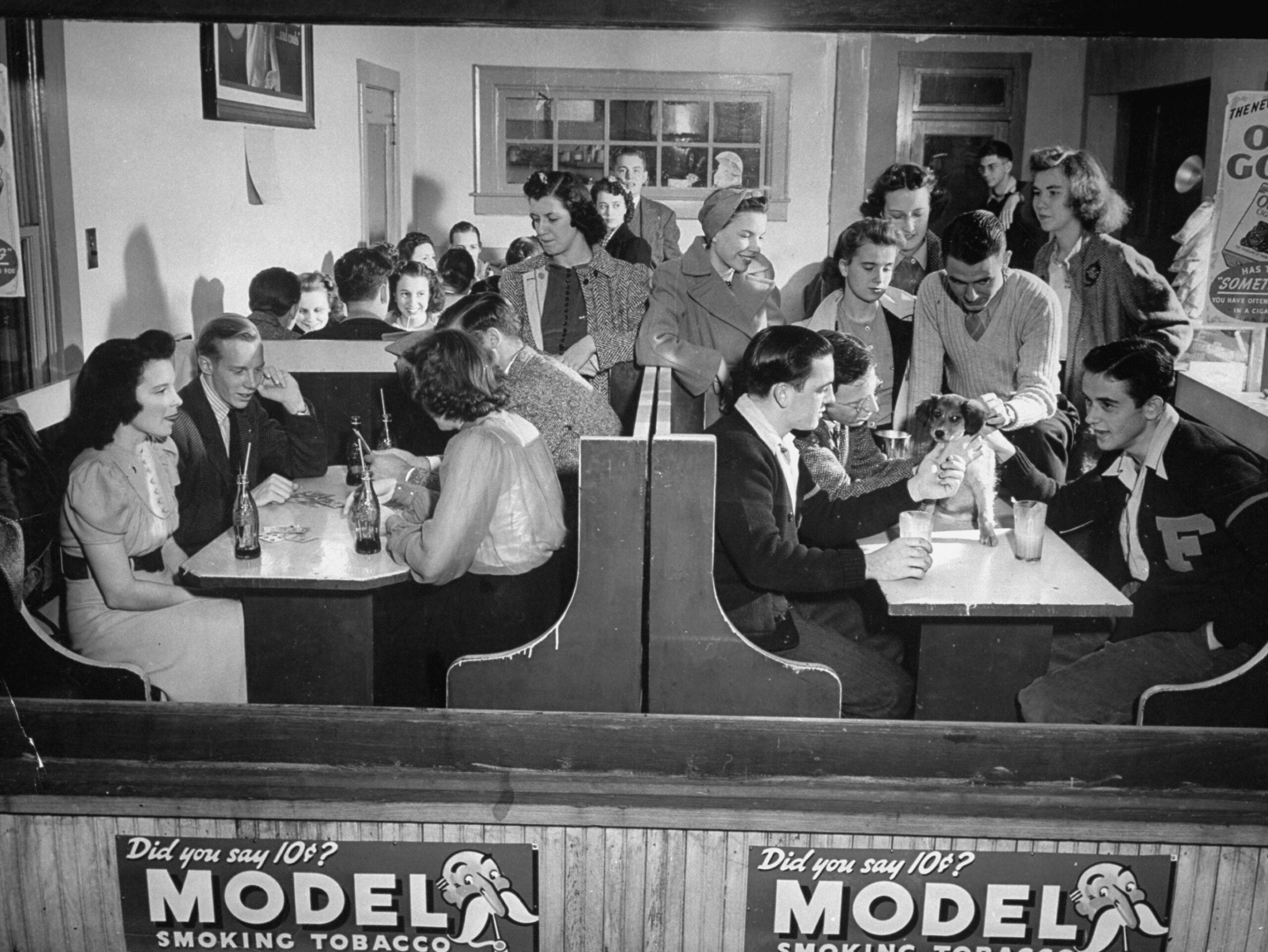
But the people out on the town weren’t all farm folk. Some came from local Franklin College—with those students likely to take over the diner or the dance hall.
Here’s how LIFE described the rituals of Saturday night in Franklin.
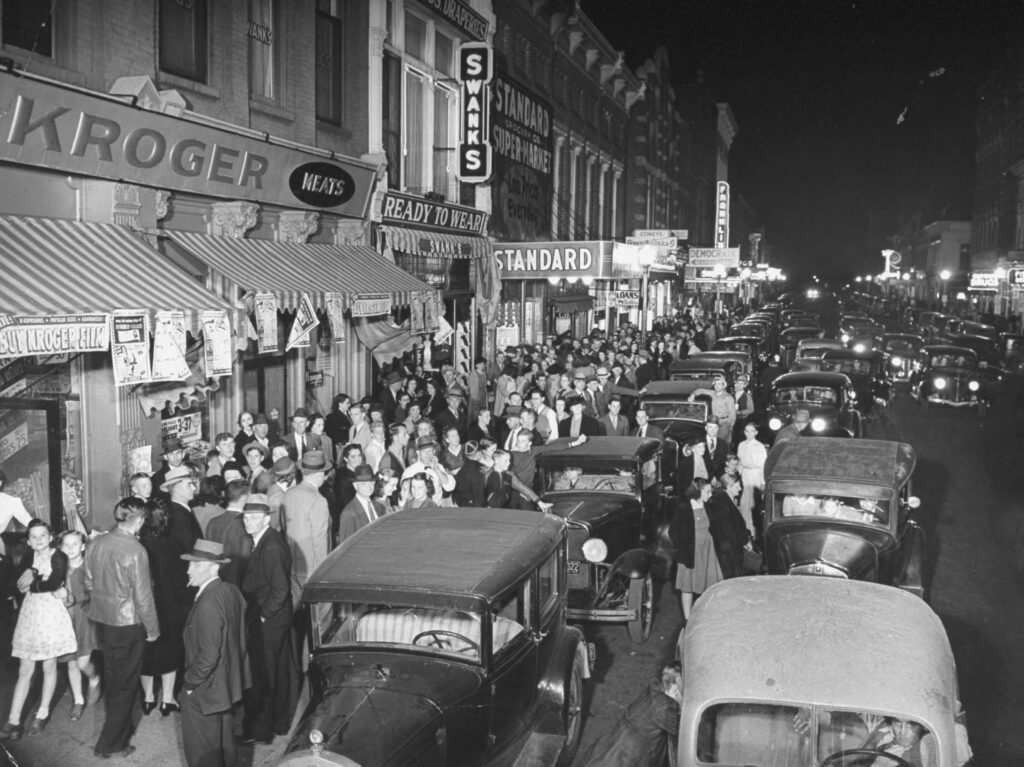
Among America’s great institutions, none is more remarkable than Saturday night in a small midwestern town. Farmers start streaming in at 7. High school musicians start playing at 8. By 8:30 main street is jammed and central square is packed three deep with cars. Nearly everybody is neatly dressed, good-natured and chatty. Nearly everybody toots his auto horn and stops to visit with friends. Women buy bargains at chain-store groceries and pack the 5-and-10. Kids clutch ice-cream cones and rush for the Wild West movie. Men retire to barbershops that hum with political discussion. At 9, the outdoor concert over, there is a final spurt of shopping. Youngsters crowd the juke-box joints for a last coke and dance.
LIFE’s assessment of Franklin could not have been more glowing as it celebrated what it called “a weekly demonstration of democratic neigborliness.”
Not everyone fell under the spell of Hoffman’s images, though. In his book American Photography and the American Dream, author James Guimond noted that LIFE chose to look at Saturday night in a town that was more thriving than most in 1940, and he termed Franklin “a stereotyped village that confirmed their nostalgic beliefs about small towns in which no one is bored, poor, or lonely.”
So it’s worth keeping in mind that when looking at these images Franklin, so full of community and joy, that the scene might have seemed as remote to some of LIFE’s readers in 1940 as it does to people viewing these images many decades later.

Jefferson Street in Franklin, Indiana, was bustling on a Saturday night, 1940.
Bernard Hoffman/Life Picture Collection/Shutterstock
The 4-H band played in the town square from 8 to 9 p.m. as part of the fun of a Saturday night in Franklin, Indiana, 1940.
Bernard Hoffman/Life Picture Collection/Shutterstock

Students from Franklin College flocked to The Nook on a Saturday night in Franklin, Indiana, 1940.
Bernard Hoffman/Life Picture Collection/Shutterstock
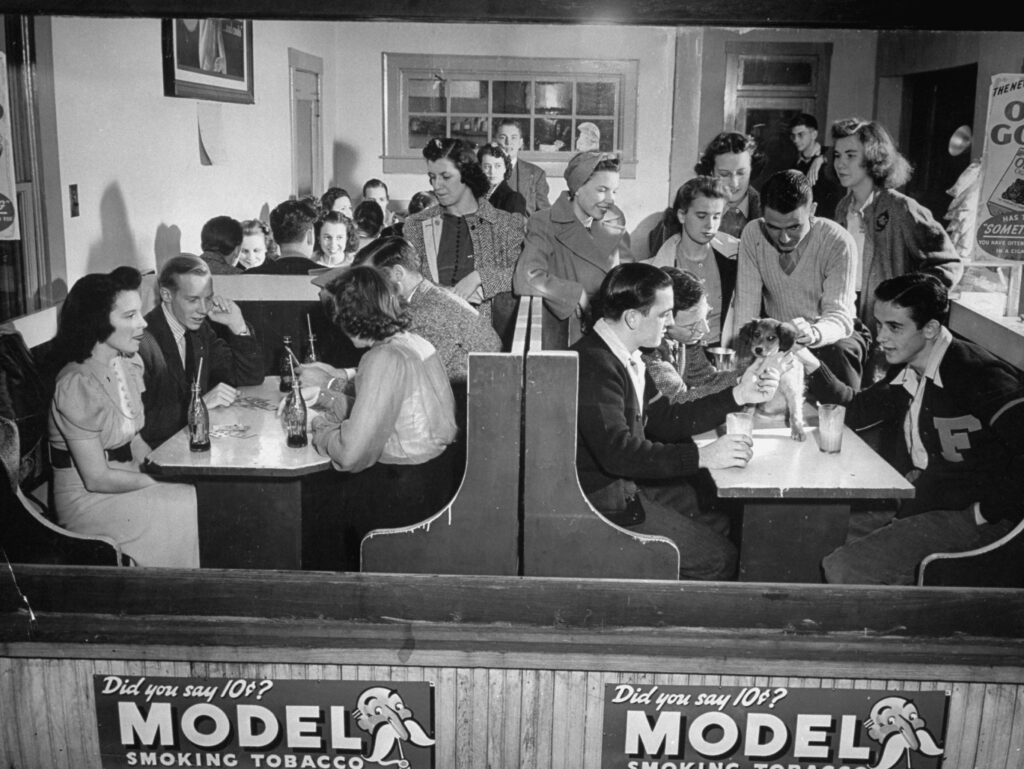
The teenagers hung out at Nick’s Candy Kitchen on a Saturday night in Franklin, Indiana, 1940.
Bernard Hoffman/Life Picture Collection/Shutterstock

The characters on a Saturday night in Franklin, Indiana, 1940, including this man hawking his “kidney tea,” 1940.
Bernard Hoffman/Life Picture Collection/Shutterstock

Duckpin bowling was the newest amusement in Franklin, Indiana on a Saturday night, 1940.
Bernard Hoffman/Life Picture Collection/Shutterstock

Ila Dean and her boyfriend Mayo Heath hit the soda shop on a Saturday night in Frankling, Indiana, 1940.
Bernard Hoffman/Life Picture Collection/Shutterstock

The Dunn family, like many farmers in their area, worked at picking pumpkins during the day before headed into town for Saturday night fun in Franklin, Indiana, 1940.
Bernard Hoffman/Life Picture Collection/Shutterstock

The Dunn family left the farm to come into the town of Franklin, Indiana for some fun and shopping on a Saturday night, 1940.
Bernard Hoffman/Life Picture Collection/Shutterstock

The Dunn family bought groceries at Krogers on a Saturday night in Franklin, Indiana, 1940; the store would run Saturday night specials for farming families like the Dunns who would come into town on that night..
Bernard Hoffman/Life Picture Collection/Shutterstock

The 5-and-10 was packed on a Saturday night in Franklin, Indiana, 1940.
Bernard Hoffman/Life Picture Collection/Shutterstock

Children of the Dunn farming family watched the Tex Ritter western “Pals of the Silver Sage” on a Saturday in Franklin, Indiana, 1940.
Bernard Hoffman/Life Picture Collection/Shutterstock

The Dunn brothers enjoyed ice cream as part of their Saturday trip in to town, Franklin, Indiana, 1940.
Bernard Hoffman/Life Picture Collection/Shutterstock

On a Saturday night in Franklin, Indiana, men would often congregate at the barbershop to talk politics, 1940.
Bernard Hoffman/Life Picture Collection/Shutterstock

For some in Franklin, Indiana, Saturday nights meant a trip to lover’s lane, 1940.
Bernard Hoffman/Life Picture Collection/Shutterstock