If you want to know why the environmental movement became a powerful force in the second half of the 20th century, look no further than then the tragedy that took place in the mill town of Donora, Pennsylvania in 1948. Twenty people died, the kind of total you might associate with a major industrial explosion. But the killer here was quieter—a deadly smog that caused respiratory illness in nearly half the town’s residents.
Smog had been a problem in Donora for years. LIFE wrote that its residents “were accustomed to the high incidence of respiratory deaths” before this incident, The magazine’s story, headlined “Death Over Donora,” described everyday conditions that feel post-apocalyptic:
The 13,000 people of Donora, Pa., perched on a hillside over a bend in the Monongahela River, are used to living under a black cloud of smoke and soot from the steel plants, the railroad yards and the Donora Zinc Works. Around the zinc works no grass grows. Even up on the hill, where a few farmers try to make a living, vegetables are covered with soot and all the sheep are black. At bedtime when Donorans put out their lights, they can still see smoke swirling across the ceilings.
The problems in Donora had been going on for a long time. In the 1920’s residents of the neighboring town of Webster had sued for damage caused to their farming operations.
But during a period of five days beginning on Oct. 27, 1948, people started dying in rapid succession. LIFE’s story described doctors running down the streets, giving adrenalin injections to people who were choking on the polluted air.
At the time of the story, the precise cause of the catastrophe was unknown. Today the Donora Historical Society and Smog Museum, a small outpost dedicated this event, said the mass deaths resulted from a combination of bad pollution and strange weather:
Sulfur dioxide emissions from U.S. Steel’s Donora Zinc Works and its American Steel & Wire plant were frequent occurrences in Donora. What made the 1948 event more severe was a temperature inversion, in which a mass of warm, stagnant air was trapped in the valley. The pollutants in the air mixed with fog to form a thick, yellowish, acrid smog that inhibited the normal process where the sun would burn off the fog. This smog hung over Donora for five days. The sulfuric acid, nitrogen dioxide, fluorine and other poisonous gases that usually dispersed into the atmosphere were caught in the inversion and continued to accumulate until rain ended the weather pattern.
If there was a silver lining from the event, it’s that it helped inspire new regulations to prevent further tragedies. In a paper published in Environmental History Review, Lynne Page Snyder of the University of Pennsylvania wrote that “Within the public health community and among federal policymakers, the Donora smog catalyzed a new approach to air pollution.” The efforts culminated in the first federal law to address the problem, the Air Pollution Act of 1955.
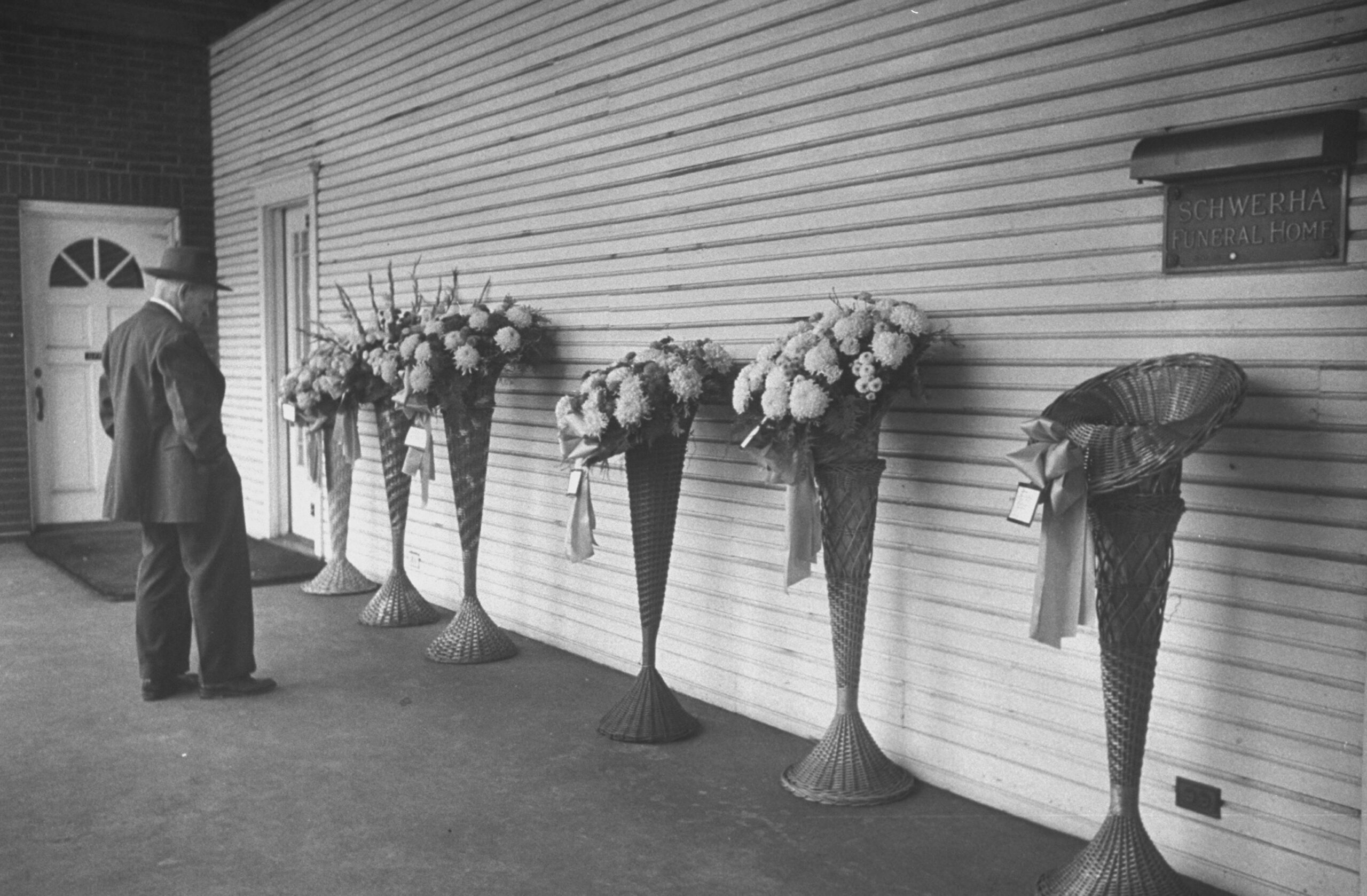
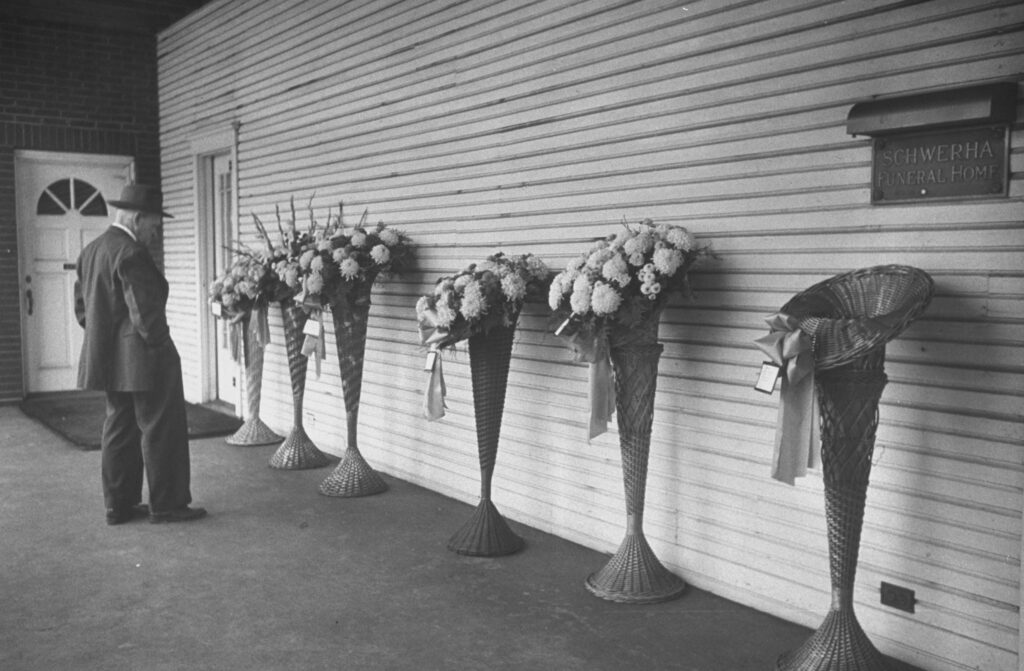
For LIFE, the photos by Alfred Eisenstaedt captured the aftermath of the tragedy in Donora. He showed hospital patients zipped up in oxygen tents that look like garment bags. He showed a farmer holding up his hands to demonstrate the town’s general sootiness. He showed flowers lined up outside a funeral parlor for the many memorials being held.
He also showed a sign on the road into town: “Donora: Next to Yours, the Best Town in the USA.” This town’s sources of civic pride included being the home of baseball great Stan Musial, who was born and raised in Donora, and who in 1948 had just won his third MVP award.
But after this history-altering tragedy, Donora had a much more unfortunate claim to fame.

In the mill town of Donora, Pa., an industrial smog killed 20 people and sickened thousands in 1948.
Alfred Eisenstaedt/Life Picture Collection/Shutterstock

Friends and family attended the funeral of Peter Starcovich, one of the first of 20 people who died from a deadly smog in the mill town of Donora, Pa., 1948.
Alfred Eisenstaedt/Life Picture Collection/Shutterstock

Flowers were lined up for the funerals being held in Donora, Pa., after a deadly smog killed 20 people in 1948.
Alfred Eisenstaedt/Life Picture Collection/Shutterstock
A worker from a zinc mill was in an oxygen tent while recovering from a deadly smog that killed 20 people in Donora, Pa., 1948.
Alfred Eisenstaedt/Life Picture Collection/Shutterstock

Patients were treated in oxygen tents after a veil of smog killed 20 people and sickened thousands in the mill town of Donora, Pa., 1948.
Alfred Eisenstaedt/Life Picture Collection/Shutterstock

Workers in the mill town of Donora, Pa, were idle due to a plant shutdown following a deadly smog that killed 20 people in 1948.
Alfred Eisenstaedt/Life Picture Collection/Shutterstock

A farmer living near the mill town of Donora, Pa. held up his hands to show the blackening effects of air pollution after a deadly smog killed 20 people and sickened thousands in 1948.
Alfred Eisenstaedt/Life Picture Collection/Shutterstock

In the mill town of Donora, Pa., an industrial smog killed 20 people and sickened thousands in 1948.
Alfred Eisenstaedt/Life Picture Collection/Shutterstock