In February 1945, LIFE magazine declared Mont-Tremblant, a resort in the Laurentian Mountains 90 miles north of Montreal, the “ski-fashion center of the world.” The reasons for Mont Tremblant’s surpassing winter-style meccas like St. Moritz and Sun Valley, according to LIFE, were two: “Many of the guests are rich, well-dressed friends of the owner, Joseph B. Ryan, grandson of financier Thomas Fortune Ryan, [and] one of the instructors is a beautiful former model, Blanche Rybizka.”
In the midst of one of the snowiest, most unsettled winters in decades, LIFE.com remembers that long-ago issue of LIFE — and the lovely Blanche Rybizka’s singular fashion sense — with a series of Alfred Eisenstaedt photos of Canadian winter scenery and winter finery.
Mont-Tremblant 1945
Alfred Eisenstaedt The LIFE Picture Collection/Shutterstock
Mont-Tremblant 1945
Alfred Eisenstaedt The LIFE Picture Collection/Shutterstock
Mont-Tremblant 1945
Alfred Eisenstaedt The LIFE Picture Collection/Shutterstock
Mont-Tremblant 1945
Alfred Eisenstaedt The LIFE Picture Collection/Shutterstock
Mont-Tremblant 1945
Alfred Eisenstaedt The LIFE Picture Collection/Shutterstock
Mont-Tremblant 1945
Alfred Eisenstaedt The LIFE Picture Collection/Shutterstock
Mont-Tremblant 1945
Alfred Eisenstaedt The LIFE Picture Collection/Shutterstock
Mont-Tremblant 1945
Alfred Eisenstaedt The LIFE Picture Collection/Shutterstock
Mont-Tremblant 1945
Alfred Eisenstaedt The LIFE Picture Collection/Shutterstock
Mont-Tremblant 1945
Alfred Eisenstaedt The LIFE Picture Collection/Shutterstock
Mont-Tremblant 1945
Alfred Eisenstaedt The LIFE Picture Collection/Shutterstock
Long before Yale Law, before Arkansas, before her marriage to Bill, before the Senate, the White House, her own runs for the White House, the State Department, and so many other highlights (and lowlights) of her remarkable life, she was Hillary Diane Rodham, the older sister of two brothers, and the over-achieving daughter of loving, politically conservative parents from suburban Park Ridge, Ill.
Intelligent, intensely curious and, from a young age, driven to find a way to contribute to the world around her, Hillary Rodham enrolled at Wellesley College in the fall of 1965. It was there, in Massachusetts, that the moderate Republican underwent her transformation (she might characterize it as “an evolution”) to committed Democrat.
By the time she graduated from Wellesley in May 1969, Hillary Rodham was already such a notable figure that she was featured, along with four other speakers from four other schools and excerpts from their commencement addresses in the June 20, 1969, issue of LIFE, in an article titled, simply, “The Class of ’69.”
Her speech was, perhaps not surprisingly, less strident and confrontational than those of the other student speakers quoted in the issue. As early as 1969, Hillary was showing signs of her ability to modulate her message without diluting or compromising it that helps explain so much of her success in public life. The other student speakers featured in that June 1969 issue included Yale’s William Thompson; Justin Simon at Brandeis; Mills College’s Stephanie Mills, an author; and Brown University’s Ira Magaziner, a high-profile student activist who went on to become a business strategist and a senior adviser in the Clinton White House.
Here, LIFE.com presents a series of pictures by photographer Lee Balterman, only one of which ran in the June 20 issue of LIFE. The images were captured at the Rodham home in Park Ridge in mid-June 1969, a week and a half after she graduated from Wellesley. Leaving aside the insights into late-Sixties fashion that these pictures afford, the LIFE archives also contains insights into the younger Hillary that never made it into the magazine. For instance, in a note dated June 11, 1969, that accompanied Balterman’s film when it was sent from Illinois to LIFE’s offices in New York, we learn that Hillary told reporter Joan Downs that “press accounts of her commencement speech were vastly different from what she actually said because the speech wasn’t written out and taped transcripts were unavailable until several days after commencement.”
“She’s also quite concerned” the note continues, “that it be made clear she was not attacking Senator Brooke personally.” Senator Edward Brooke, the first African-American elected to the Senate and the last Republican Senator elected from Massachusetts until Scott Brown’s election in 2010, spoke before Hillary Rodham at Wellesley’s commencement, and she deviated from her prepared remarks to address at least part of what he said.
Another Balterman note in the archive, meanwhile, written in the photographer’s own hand, points to a less dramatic, if no less revealing, element of the photo shoot: “Had to go for nothing more than informal portraits, but should be some good expressions & hand gestures, etc.,” the note reads, before ending with a simple, gentle suggestion: “Her glasses helped.”
—Photo gallery edited by Liz Ronk
Hillary Rodham (later Hillary Rodham Clinton), Park Ridge, Illinois, June 1969.
Lee Balterman/Life Pictures/Shutterstock
Hillary Rodham (later Hillary Rodham Clinton), Park Ridge, Illinois, June 1969.
Lee Balterman/Life Pictures/Shutterstock
Hillary Rodham (later Hillary Rodham Clinton), Park Ridge, Illinois, June 1969
Lee Balterman/Life Pictures/Shutterstock
Hillary Rodham (later Hillary Rodham Clinton), Park Ridge, Illinois, June 1969.
Lee Balterman/Life Pictures/Shutterstock
Hillary Rodham (later Hillary Rodham Clinton), Park Ridge, Illinois, June 1969
Lee Balterman/Life Pictures/Shutterstock
This image appeared in the June 20, 1969, issue of LIFE.
Lee Balterman/Life Pictures/Shutterstock
Hillary Rodham (later Hillary Rodham Clinton), Park Ridge, Illinois, June 1969
Lee Balterman/Life Pictures/Shutterstock
Hillary Rodham (later Hillary Rodham Clinton), Park Ridge, Illinois, June 1969.
Lee Balterman/Life Pictures/Shutterstock
Hillary Rodham (later Hillary Rodham Clinton), Park Ridge, Illinois, June 1969.
Lee Balterman/Life Pictures/Shutterstock
Hillary Rodham (later Hillary Rodham Clinton), Park Ridge, Illinois, June 1969
Lee Balterman/Life Pictures/Shutterstock
Hillary Rodham (later Hillary Rodham Clinton), Park Ridge, Illinois, June 1969
Lee Balterman/Life Pictures/Shutterstock
Hillary Rodham (later Hillary Rodham Clinton), Park Ridge, Illinois, June 1969.
Lee Balterman/Life Pictures/Shutterstock
hillary-clinton-in-1969-14
Life Magazine
LIFE magazine, June 20, 1969, “Class of ’69” page spreads.
LIFE magazine, June 20, 1969, “Class of ’69” page spreads.
Artists and engineers share this bond: their visions are often first embodied in rough, rudimentary form. Whether it’s a sculptor working in clay or an industrial designer using three-dimensional software, modeling is not just part of the creative process: to a large degree, it is the creative process.
For NASA’s engineers, finding ways to model the remarkable craft that would not only land astronauts on the moon, but would allow them to lift off from the lunar surface, rendezvous and link up with an orbiting vessel and return safely to Earth and their families well, tackling that sort of challenge is the reason so many of the best and brightest join NASA in the first place.
Here, LIFE.com offers a series of images celebrating the various Lunar Excursion Modules—scale-model and life-size—that NASA built through the years; the men who flew them; and the brilliant, daring minds that envisioned the extraordinary spacecraft in the first place.
First deployed during Apollo 9’s 10-day mission in March 1969, roughly 100 miles above the earth, and tested again a few months later, less than 10 miles above the lunar surface during Apollo 10’s “dry run” for the July 1969 moon landing, the various versions of the lunar module that NASA designed and produced represent, in microcosm, pretty much everything technological that got people excited about the American space program in the 1960s.
After all, behind the craft’s complex development is an audaciously straightforward idea—enter moon’s orbit; separate from command module; land on moon; lift off from moon; reconnect with command module; come home—that would take years of effort (and not a few mistakes) to finally put into triumphant, era-defining practice.
In July 1969, when Apollo 11’s rendition of the LEM, Eagle, touched down on a vast lunar plain named Mare Tranquillitatis, or the Sea of Tranquility, centuries before by two Italian astronomers Neil Armstrong radioed a simple, momentous phrase to Mission Control a quarter-million miles away in Houston.
“The Eagle has landed,” he said, cementing the lunar module’s central role in one of humanity’s greatest dramas.
Early lunar module model, in wood, 1960s
Yale Joel The LIFE Picture Collection/Shutterstock
Early lunar module model, 1960s.
Yale Joel The LIFE Picture Collection/Shutterstock
Lunar module model, 1969
Yale Joel The LIFE Picture Collection/Shutterstock
A sketch made by Dr. John C. Houbolt in 1961 for a lunar module, later adopted by NASA for Apollo 9.
Arthur Schatz The LIFE Picture Collection/Shutterstock
This sketch made by Dr. John C. Houbolt in 1961 shows a modular concept much like the one that was ultimately adopted by NASA for the Lunar Excursion Module.
Arthur Schatz The LIFE Picture Collection/Shutterstock
A sketch by Dr. John C. Houbolt suggested a design for a moon landing craft designated the “Lunar Schooner,” in 1961
Arthur Schatz The LIFE Picture Collection/Shutterstock
A full-scale model of the Lunar Excursion Module, 1969.
The LIFE Picture Collection/Shutterstock
An astronaut descended the lunar module ladder during an enactment of a moon landing during a training exercise, 1967.
Ralph Morse The LIFE Picture Collection/Shutterstock
Apollo 9 and the lunar module, 1969
NASA
Apollo 9, March 1969. On the fourth day of the mission, astronaut David Scott stood in the open hatch of the command module and scanned the blue earth below.
NASA
The Apollo 9 Lunar Module, a.k.a., “Spider,” remained attached to the Saturn rocket stage while in low Earth orbit, March 1969.
NASA
The Apollo 9 Lunar Module (a 30,000 lb. vessel nicknamed “Spider” by crew members Scott, McDivitt and Schweichkart), 100 miles above the Atlantic Ocean, March 1969.
NASA
The Apollo 10 command module, piloted by astronaut John Young on his third space flight, entered into low orbit above the moon in May 1969 during a “dry run” for the July 1969 moon landing. The lunar module on this mission was nicknamed “Snoopy”; the command module was nicknamed “Charlie Brown.” (Charlie Brown, after all, rarely gets to have any fun. The same could not possibly be said of Young himself: he made six space flights over his 40-year career with NASA, and remains the only astronaut to have piloted four distinct classes of spacecraft: Gemini; the Apollo command and lunar modules; and the Space Shuttle.)
NASA
During Apollo 11’s historic moon mission in July 1969, astronaut Buzz Aldrin unfurled a “solar wind sheet” designed to collect atomic particles blowing from the distant sun. The Lunar Excursion Module, which got Aldrin and Neil Armstrong safely to and from the lunar surface, stood behind him.
NASA
With the Earth visible in the distance above the moon’s horizon, Apollo 11’s lunar module ascended toward the command module (piloted by astronaut Michael Collins while Armstrong and Aldrin were on the lunar surface).
Shirley Temple Black—known to millions as simply Shirley Temple, who acted in scores of movies and was arguably the greatest child movie star of all time—was a constant presence on the silver screen during the Great Depression, lighting up movies like Stand Up and Cheer!and Bright Eyes with her singing, dancing and her sharp (but never cloying) wit. She retired from the movies when she was just 21, in 1950, and continued with her remarkable life, shifting into the world of international politics. She held a number of diplomatic posts during her lifetime, including U.S. ambassador to Czechoslovakia during that country’s convulsive years in the late 1980s.
After her death, Temple Black’s family paid tribute to her in a statement that read, in part, “We salute her for a life of remarkable achievements as an actor, as a diplomat, and most importantly as our beloved mother, grandmother, great-grandmother, and adored wife for fifty-five years of the late and much missed Charles Alden Black.”
Liz Ronk edited this gallery for LIFE.com. Follow her on Twitter at @LizabethRonk.
Shirley Temple arrived at the 20th Century Fox studio to celebrate her eighth birthday, 1936.
Alfred Eisenstaedt The LIFE Picture Collection/Shutterstock
Shirley Temple celebrated her eighth birthday at 20th Century Fox in 1936, when, in the middle of the Great Depression, she was the biggest box office star in America.
Alfred Eisenstaedt The LIFE Picture Collection/Shutterstock
Shirley Temple celebrated her eighth birthday, 1936.
Alfred Eisenstaedt The LIFE Picture Collection/Shutterstock
Shirley Temple celebrated her eighth birthday, 1936.
Alfred Eisenstaedt The LIFE Picture Collection/Shutterstock
Shirley Temple, 1936.
Alfred Eisenstaedt The LIFE Picture Collection/Shutterstock
Shirley Temple, 1936.
Alfred Eisenstaedt The LIFE Picture Collection/Shutterstock
Shirley Temple took pictures of famous sites in Washington, DC, from the window of a car, 1938.
Thomas D. McAvoy The LIFE Picture Collection/Shutterstock
Shirley Temple at the Lincoln Memorial, 1938.
Thomas D. McAvoy The LIFE Picture Collection/Shutterstock
Federal Bureau of Investigation director J. Edgar Hoover showed Shirley Temple how to ride a mechanical horse, 1938.
Thomas D. McAvoy The LIFE Picture Collection/Shutterstock
Shirley Temple, photographed as she was leaving the White House, 1938.
Thomas D. McAvoy The LIFE Picture Collection/Shutterstock
Shirley Temple walked on the steps of the U.S. Capitol.
Thomas D. McAvoy The LIFE Picture Collection/Shutterstock
Shirley Temple walked down stairs at the Bel Air Country Club at her 11th birthday party, 1939.
Peter Stockpole The LIFE Picture Collection/Shutterstock
Shirley Temple with Sgt. John Agar, to whom she was married from 1945-1950.
Peter Stockpole The LIFE Picture Collection/Shutterstock
In November 1964, LIFE magazine noted that “a small dog with a sweeping hairdo and a peppery disposition” was pushing the poodle aside as the elegant canine accessory-of-the-moment. LIFE also noted that the small, dynamic Yorkie — for it was none other than the Yorkshire Terrier to which the magazine devoted a multi-page feature — “is no lap dog. It has the dash and spirit of all terriers and is a better ratter than most cats.”
The image of a fearless rat-killer is hardly the first that comes to mind, of course, when one thinks of the Yorkie — and the Nina Leen photos in that LIFE feature focused on the breed’s cute, lively nature rather than its innate (if rarely exercised) ferocity. But the point was clear: while small in stature, the Yorkie has huge appeal.
Here, LIFE presents some of Leen’s pictures from 50 years ago — photos celebrating a rare and singularly winning breed.
Liz Ronk edited this gallery. Follow her on Twitter @lizabethronk.
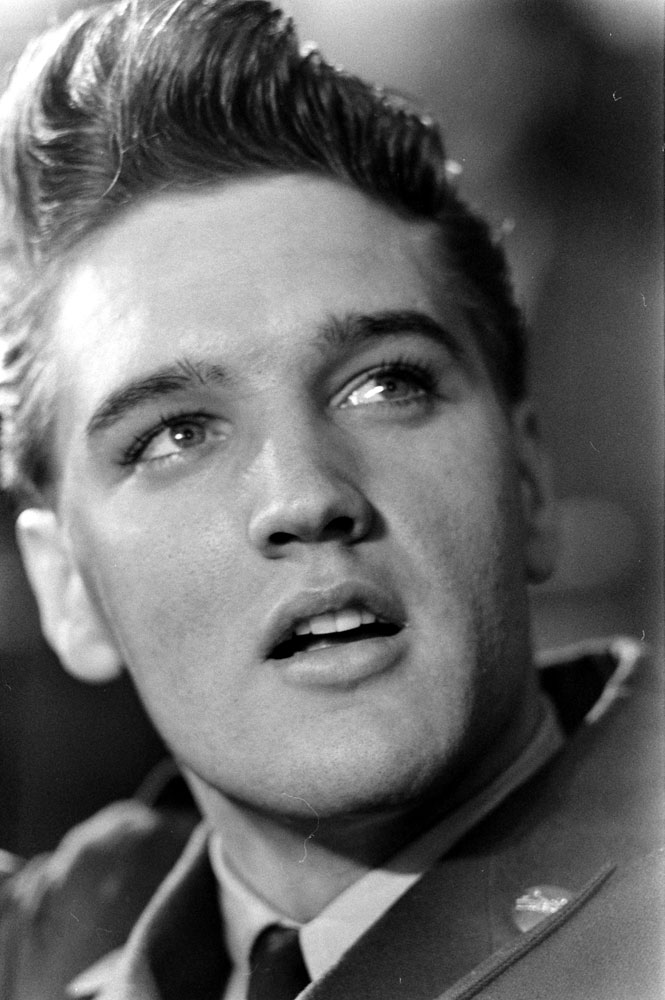
It’s intriguing to imagine contemporary American music stars serving in the military. How would Kanye West fare in the Air Force? Would Adam Levine cut it in the Army? But when a young man who was, at the time, the biggest musical star on the planet was drafted into the United States Army back in 1958, the uniform seemed to fit. Sure, Elvis Aron Presley often affected a sneer that would drive most drill sergeants to near-apoplexy, and his pompadour was hardly the sort of hairstyle one associated with military discipline. But Elvis, born in Tupelo, Mississippi and raised in Tennessee, had humble Southern roots that may have allowed for a more seamless transition from pop-culture icon to buck private.
Whatever the reason, for a couple of years, Elvis Presley looked like he belonged in a uniform and by all accounts, his brothers in arms saw what he was made of, and accepted him as one of them. It was impossible, of course, for anyone to pretend that Elvis was just another soldier; but he worked hard to fit in and to do what was asked of him, and after two years, when Sgt. Presley was honorably discharged, it was evident that the boy from Tupelo had grown up.
It was also evident, that Elvis was hardly heartbroken about leaving the military. His two years serving in Germany had shown the world, and had shown Elvis himself, that he could handle something more than a guitar, and could perform tasks that didn’t involve gyrating in front of screaming bobbysoxers. In 1960, it was time to get back to doing what he did best: it was time to leave Sgt. Presley behind, and be Elvis again.
Here, LIFE.com presents a series of photos—most of which never ran in LIFE magazine—showing Elvis, along with his 15-year-old girlfriend, Priscilla Beaulieu, in Germany on the day he left to return to the States (March 2, 1960), and Elvis again at Fort Dix, New Jersey, where he landed on March 3, sans Priscilla. He was officially discharged from the Army on March 5. These pictures, by LIFE photographers James Whitmore and Al Fenn, capture a moment in Elvis’s life when he was poised to remind everyone who may have doubted it that, despite two years of taking orders, he was ready to again be the King.
A few weeks later, in its March 14, 1960, issue, LIFE put it this way to its millions of readers:
“In a spectacular shift of power that critically exposed the flank of U.S. music lovers, the Army returned US53310761 from Germany last week for mustering out at Fort Dix, N.J. Fans mobilized to fighting strength and tuned up their shrieks . . . Elvis was back. After his two year hitch, rock and roll idol Elvis Presley wore a sergeant’s chevrons but no sideburns. “If I say the Army made a man of me,” he said, “it would give the impression I was an idiot before I was drafted. I wasn’t exactly that.” Elvis was, in fact, a smart soldier. His agents back home had been pretty smart, too, selling 20 million RCA Victor records to the jukebox set. These earned “The Pelvis” $1.3 million in addition to his $145.24 a month service pay. Elvis paid the U.D. 91% of the total in taxes, or enough to support about 150 of his fellow soldiers for a year. Behind him at Ray Barracks near Friedberg, Elvis had left hordes of palpitating Fräuleins and the pretty 16-year-old Priscilla Beaulieu, daughter of an Air Force captain stationed at Wiesbaden. Elvis kissed her before he flew to the aid of the girls back home, sorrowful at parting but anxious to get into his bright-colored pants and back to his hip-swinging singing.”
Sgt. Elvis Presley prepared to leave Germany, March 1960.
James Whitmore/Life Pictures/Shutterstock
Sgt. Elvis Presley prepared to leave Germany, March 1960.
James Whitmore/Life Pictures/Shutterstock
Sgt. Elvis Presley prepared to leave Germany, March 1960.
James Whitmore/Life Pictures/Shutterstock
Sgt. Elvis Presley prepared to leave Germany, March 1960.
James Whitmore/Life Pictures/Shutterstock
Sgt. Elvis Presley held a press conference before leaving Germany, March 1960.
James Whitmore/Life Pictures/Shutterstock
Sgt. Elvis Presley held a press conference before leaving Germany, March 1960.
James Whitmore/Life Pictures/Shutterstock
Sgt. Elvis Presley held a press conference before leaving Germany, March 1960.
James Whitmore/Life Pictures/Shutterstock
Sgt. Elvis Presley held a press conference before leaving Germany, March 1960.
James Whitmore/Life Pictures/Shutterstock
Sgt. Elvis Presley held a press conference before leaving Germany, March 1960.
James Whitmore/Life Pictures/Shutterstock
Sgt. Elvis Presley prepared to leave Germany, March 1960.
James Whitmore/Life Pictures/Shutterstock
Sgt. Elvis Presley peered out of the window of the house he and his family occupied in Bad Nauheim, Germany, March 1960.
James Whitmore/Life Pictures/Shutterstock
Sgt. Elvis Presley left the house he and his family occupied in Bad Nauheim, Germany, March 1960.
James Whitmore/Life Pictures/Shutterstock
Elvis Presley’s grandmother and Priscilla Beaulieu left the house that Elvis and his family occupied in Bad Nauheim, Germany, March 1960
James Whitmore/Life Pictures/Shutterstock
Sgt. Elvis Presley left the house he and his family occupied in Bad Nauheim, Germany, March 1960.
James Whitmore/Life Pictures/Shutterstock
Priscilla Beaulieu rode in the back seat with Elvis as German fans crowded around the car.”
James Whitmore/Life Pictures/Shutterstock
Elvis and Priscilla left the house he and his family occupied in Bad Nauheim, Germany, March 1960.
James Whitmore—Time & Life Pictures/Shutterstock
Elvis and Priscilla left the house he and his family occupied in Bad Nauheim, Germany, March 1960.
James Whitmore/Life Pictures/Shutterstock
Elvis and Priscilla left the house he and his family occupied in Bad Nauheim, Germany, March 1960.
James Whitmore/Life Pictures/Shutterstock
Elvis and Priscilla left the house he and his family occupied in Bad Nauheim, Germany, March 1960.
James Whitmore/Life Pictures/Shutterstock
Sgt. Elvis Presley prepared to leave Germany, March 1960.
James Whitmore/Life Pictures/Shutterstock
Priscilla Beaulieu, Germany, March 1960.
James Whitmore/Life Pictures/Shutterstock
Priscilla Beaulieu waved to Elvis as the plane took off from Germany for the U.S.
James Whitmore/Life Pictures/Shutterstock
Sgt. Elvis Presley prepared to leave Germany, March 1960.
James Whitmore/Life Pictures/Shutterstock
Priscilla Beaulieu, Germany, March 1960.
James Whitmore/Life Pictures/Shutterstock
Priscilla Beaulieu was escorted from the tarmac after saying goodbye to Elvis, Germany, March 1960.
James Whitmore/Life Pictures/Shutterstock
Elvis Presley fans congregated at the house in which Elvis and his family lived, shortly after he left the house for the last time, Bad Nauheim, Germany, March 1960.
James Whitmore/Life Pictures/Shutterstock
Elvis Presley fans, McGuire Air Force Base, New Jersey, March 1960.
Al Fenn/Life Pictures/Shutterstock
Elvis Presley fan, McGuire Air Force Base, New Jersey, March 1960.
Al Fenn/Life Pictures/Shutterstock
Elvis Presley fan, McGuire Air Force Base, New Jersey, March 1960.
Al Fenn/Life Pictures/Shutterstock
Elvis Presley fans, McGuire Air Force Base, New Jersey, March 1960.
Al Fenn/Life Pictures/Shutterstock
Elvis Presley arrived at McGuire Air Force Base, New Jersey, March 1960.
Al Fenn/Life Pictures/Shutterstock
Elvis Presley fans, McGuire Air Force Base, New Jersey, March 1960.
Al Fenn/Life Pictures/Shutterstock
Elvis Presley arrived at McGuire Air Force Base, New Jersey, March 1960.
Al Fenn/Life Pictures/Shutterstock
Elvis Presley fans, McGuire Air Force Base, New Jersey, March 1960.
Al Fenn/Life Pictures/Shutterstock
Elvis Presley arrived at McGuire Air Force Base, New Jersey, March 1960.
Al Fenn/Life Pictures/Shutterstock
Elvis Presley fan, McGuire Air Force Base, New Jersey, March 1960.
Al Fenn/Life Pictures/Shutterstock
Elvis Presley fans, McGuire Air Force Base, New Jersey, March 1960.
Al Fenn/Life Pictures/Shutterstock
Elvis Presley fan, McGuire Air Force Base, New Jersey, March 1960.
Al Fenn/Life Pictures/Shutterstock
Elvis Presley fans, McGuire Air Force Base, New Jersey, March 1960.
Al Fenn/Life Pictures/Shutterstock
Elvis Presley fan, McGuire Air Force Base, New Jersey, March 1960.
Al Fenn/Life Pictures/Shutterstock
Elvis Presley at Fort Dix, New Jersey, shortly before his discharge from the U.S. Army, March 1960.
Al Fenn/Life Pictures/Shutterstock
Elvis Presley at Fort Dix, New Jersey, shortly before his discharge from the U.S. Army, March 1960.
Al Fenn/Life Pictures/Shutterstock
Elvis Presley at Fort Dix, New Jersey, shortly before his discharge from the U.S. Army, March 1960.
Al Fenn—Time & Life Pictures/Shutterstock
Elvis Presley at Fort Dix, New Jersey, shortly before his discharge from the U.S. Army, March 1960.
Al Fenn/Life Pictures/Shutterstock
Elvis Presley at Fort Dix, New Jersey, shortly before his discharge from the U.S. Army, March 1960.
Al Fenn/Life Pictures/Shutterstock
Elvis Presley at Fort Dix, New Jersey, shortly before his discharge from the U.S. Army, March 1960.
Al Fenn/Life Pictures/Shutterstock
Elvis Presley at Fort Dix, New Jersey, shortly before his discharge from the U.S. Army, March 1960.
Al Fenn/Life Pictures/Shutterstock
Elvis Presley at Fort Dix, New Jersey, shortly before his discharge from the U.S. Army, March 1960.
Al Fenn/Life Pictures/Shutterstock
Elvis Presley at Fort Dix, New Jersey, shortly before his discharge from the U.S. Army, March 1960.
Al Fenn/Life Pictures/Shutterstock
Elvis Presley at Fort Dix, New Jersey, shortly before his discharge from the U.S. Army, March 1960.
Al Fenn/Life Pictures/Shutterstock
lvis Presley at Fort Dix, New Jersey, shortly before his discharge from the U.S. Army, March 1960.
Al Fenn/Life Pictures/Shutterstock
lvis Presley at Fort Dix, New Jersey, shortly before his discharge from the U.S. Army, March 1960.
Al Fenn/Life Pictures/Shutterstock
Elvis Presley (and, at right, actress Tina Louise) at Fort Dix, New Jersey, shortly before his discharge from the U.S. Army, March 1960.
Al Fenn/Life Pictures/Shutterstock
Elvis Presley at Fort Dix, New Jersey, shortly before his discharge from the U.S. Army, March 1960.
Al Fenn/Life Pictures/Shutterstock
Elvis Presley at Fort Dix, New Jersey, shortly before his discharge from the U.S. Army, March 1960.
Al Fenn/Life Pictures/Shutterstock
Subscribe to the LIFE Newsletter
Travel back in time with treasured photos and stories, sent right to your inbox


![For skiing at 40 degrees below zero Blanche [Rybizka] wears a deerhide jacket, a raccoon-edged hood, fur-lined mittens and two pairs of underwear under her trim pants.](https://static.life.com/wp-content/uploads/migrated/2014/12/141205-canada-winter-fashions-02-792x1024.jpg "Mont-Tremblant 1945")